
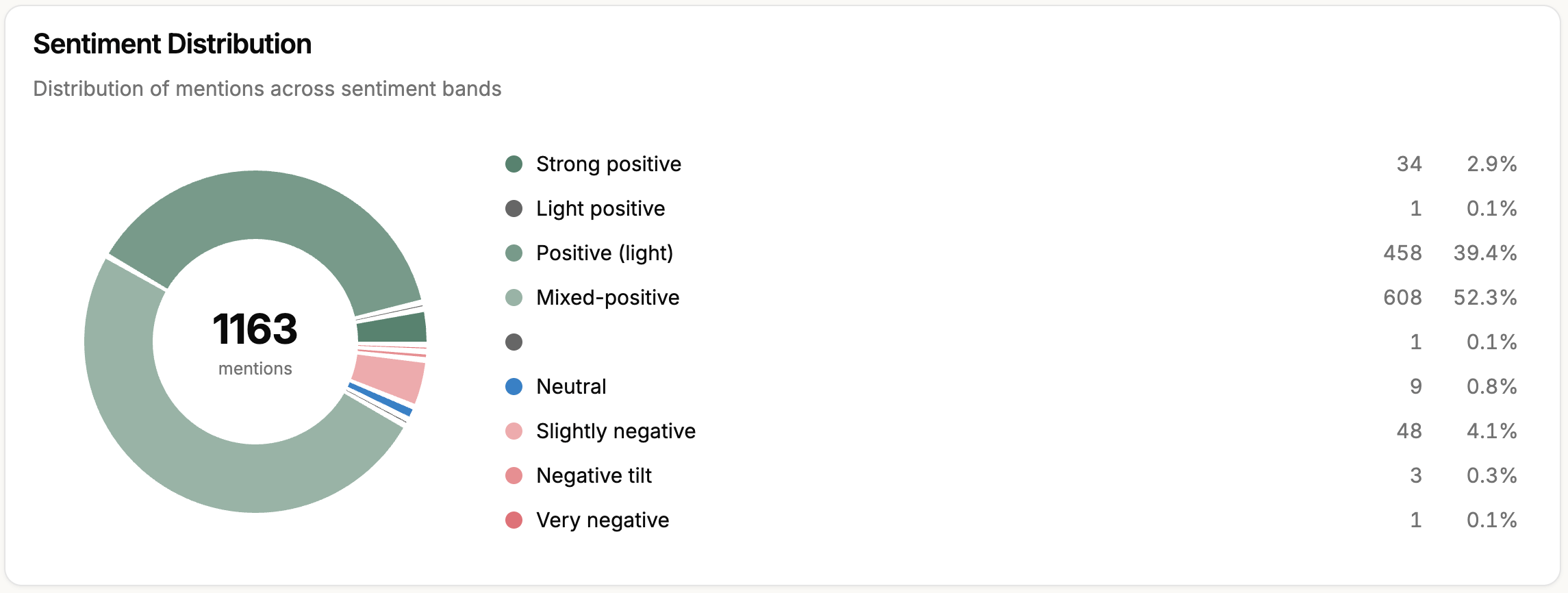
Why is not positive, neutral, negative enough?
A three-bucket sentiment summary tells you the outcome, not the cause. It is like a doctor saying your bloodwork looks mostly fine without showing the actual values. AI perception is a composite signal, not a single thing. A brand can score well on Language Tone while scoring poorly on Competitive Position because every recommendation list places them third or fourth. The aggregate reads as neutral. The reality is specific, and fixable. Consider two brands in the same category. Brand A gets positive language but is always mentioned as an afterthought after two competitors. Brand B gets slightly uncertain language but is consistently the first recommendation. Standard sentiment says Brand A is positive. KIME shows Brand A has a Competitive Position problem that no amount of good press will fix on its own. To give you something actionable, you need to know which component is moving and in which direction. That is what AI Perception scores.
What are the 8 factors that drive your AI Perception score?
When KIME analyzes an AI response about your brand, it applies a deterministic, rule-based scoring algorithm to the raw text. No black box, no vague AI sentiment. The algorithm measures 8 distinct dimensions of every response. Together they do not just tell you what AI is saying about you. They tell you why you scored the way you did, and what you can actually do about it.- Language Tone
- Competitive Position
- Brand Focus
- Endorsements
- Source Credibility
- Information Recency
- Risk Factors
- Confidence Level
How do you read your AI Perception score breakdown?
Every brand’s AI Perception score is a combination of these 8 factors, but they do not all contribute equally and they do not all move in the same direction at the same time. The KIME dashboard surfaces this as a ranked breakdown, so you can see at a glance what is helping and what is hurting. The strategic insight is that you do not need to optimize all 8 factors at once. The right approach is to identify the one or two factors with the largest negative influence on your current score, understand why they are underperforming, and address those first. A brand with strong Language Tone and Endorsement scores but a weak Source Credibility score has a different problem, and a different fix, than a brand with strong Source Credibility but poor Competitive Position. The score breakdown is designed to make that distinction obvious.Why does the same brand score differently across AI models?
One pattern that consistently surprises brands is how much the score can vary across models. The same brand can look meaningfully different across models in the same time period. The practical takeaway is not that one number is right and another is wrong. It is that users encounter different answer environments across models, and your brand can be framed differently depending on where they ask. That is why AI perception should not be treated as a single number. Cross-model variance is valuable because it shows where your brand is strongest, where it is weakest, and where monitoring should be prioritized first.What should you do when a specific factor is pulling your score down?
AI Perception is diagnostic by design. The score tells you where you are. The factor breakdown tells you why. But the key is that KIME does not stop at the label: it shows you the exact AI excerpts that created each signal, along with the sources the model cited in that answer. So when a factor is dragging you down, you are not guessing. You can see the wording, ranking, warning, or outdated claim itself, and the source behind it.- Low Language Tone - Audit the content AI is retrieving about you. Look for high-traffic negative reviews or critical editorial coverage. Build positive coverage from authoritative sources using specific, strong language.
- Low Competitive Position - You are not appearing early enough in AI comparison outputs. Invest in shortlist and best-of editorial coverage. Improve third-party review scores on platforms AI uses as sources.
- Low Brand Focus - AI does not have enough to say about you specifically. Create deeper, topic-specific content and build coverage where you are the subject, not a supporting mention.
- Low Endorsements - AI mentions you but doesn’t actively recommend you. Create case studies and get them picked up by authoritative third-party sites. Pitch “best for X” editorial coverage in recognized outlets in your category.
- Low Source Credibility - Your brand is mentioned most by low-authority sources. Prioritize earned media in tier-one publications and recognized trade outlets. Get onto established review platforms.
- Low Information Recency - AI is drawing on old information. Publish and distribute updated content, and actively pitch recent milestones and product updates.
- High Risk Factors - A past issue is still surfacing in AI responses. Address it with authoritative, accurate content and build enough positive signal to reduce the proportional weight of risk mentions.
- Low Confidence Level - Claims about your brand are not well corroborated. Get the same positive facts referenced across multiple independent, high-authority sources.
Frequently Asked Questions
What is an AI perception score? An AI perception score is a composite measure of what AI language models actually say about your brand in their outputs. KIME calculates it by applying a deterministic, rule-based algorithm to real AI responses and measuring 8 dimensions of each response: Language Tone, Competitive Position, Brand Focus, Endorsements, Source Credibility, Information Recency, Risk Factors, and Confidence Level. Why do AI perception scores vary across models? A brand that scores well in one model may score poorly in another because the answers users see can vary meaningfully across models. How is AI perception different from traditional brand sentiment? Traditional brand sentiment tracks how humans describe your brand in reviews, social media, and press. AI perception tracks how AI models describe your brand in their outputs, which is a different signal driven by different sources. How often does an AI perception score change? Scores can shift within days if a meaningful new piece of content, positive or negative, enters the sources AI retrieves from. KIME tracks your score over time so you can correlate changes with specific content and coverage events. What is the fastest way to improve a low AI perception score? The fastest improvement usually comes from addressing the single factor with the largest negative impact on your current score. Source Credibility and Information Recency tend to respond fastest to targeted action.How do you get started with AI Perception tracking?
AI Perception is live in KIME today. Here is how to run your first analysis:- Connect your brand - Add your brand name and the competitor set you want to track. KIME starts pulling real AI responses immediately.
- Set your tracked queries - Choose the prompts AI users are most likely to ask when evaluating your category. KIME scores your brand across all of them.
- Open your Perception dashboard - Your factor breakdown appears automatically, with each dimension ranked by impact and the AI excerpts behind every score available behind a click.